

We saw in a previous article (Not All Offices Are Created Equal) that noise control in an office environment can be a tricky subject, with many considerations needed of the surroundings. Noise is just unwanted sound, so we need to find ways to reduce this noise transference in specific areas, such as meeting rooms, cellular offices, and kitchen areas as a few examples. Also bear in mind that sometimes we want to keep the noise in, but other times we will want to keep it out.
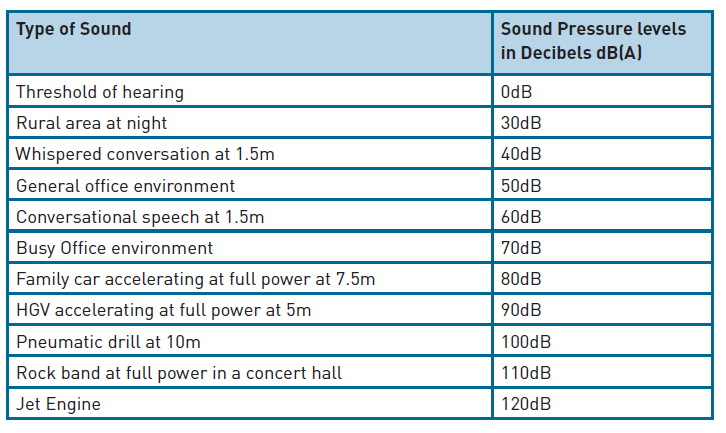
If we put noise into some context, the table below shows some typical decibel levels:
Office Partitions
In almost all cases, a meeting room or individual office in a normal commercial environment will be created using some form of lightweight, demountable partition, whether it be solid, glazed, or a combination of the two. But it could also be constructed from bricks and blocks.
This partition will be constructed using various materials that will assist in the reduction of noise transference through absorption, reflection, and insulation. Different materials will produce different results, as will the wall thickness. So how can this noise reduction be identified, given the numerous types of material available?
Acoustic Testing of Dividing Partitions
The prevention of the passage of sound from one space to another is known as attenuation. The ability of a partition or door to prevent the passage of airborne sound is known as the sound insulation and is normally referred to as the Sound Reduction Index (SRI).
The SRI is measured by testing a partition sample for resistance to the passage of airborne sound in an acoustic laboratory in accordance with EN ISO 10140-1 & 2. The result is expressed in dB(Rw) in accordance with EN ISO 717-1, often referred to as the Weighted Sound Reduction. For verified results, the tests need to be performed at a UKAS (United Kingdom Accreditation Service) facility. This allows direct comparisons of tested products.
How Are The Tests Done?
In simple terms, within the UKAS test facility will be a room where the tests take place. In the room will be a dividing wall with an opening – the opening dimension will vary from facility to facility, but will generally be approximately 3 metres wide and 3 metres high.
The product to be tested will be constructed within the fixed opening, ensuring that all gaps are closed and sealed in order to get the best possible results.

On one side of the dividing wall, in the Source Room, will be a sound source and a sound level meter. On the other side, the Receiving Room, will be a second sound level meter.
Noise from the sound source will be measured across a prescribed frequency spectrum (normally 100 – 3150Hz) in both the Source Room and the Receiving Room. The difference between the two measurements is referred to as the Sound Reduction Index (SRI).
With SRI values, the bigger the difference between the measurements, the better the performance of the product being tested. The results will be calculated using a standard formula, and will be expressed as a dB(Rw) rating.
Any published test data should always include the following;
- a full set of data with the graph and weighted SRI
- a detailed description of the sample tested
- the date of the test, and the laboratory test reference
- the test specimen size
So What Does This All Mean To Me?
So all of this means that we are able to compare the acoustic performance of different products and systems, safe in the knowledge that we are comparing apples for apples.
It also allows us to understand what level of acoustic performance we may get if we install the product in an office environment. The table below demonstrates what the weighted sound reduction performance means in real terms.
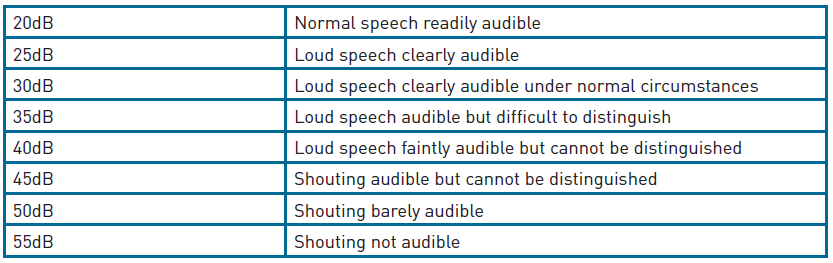
From the above table we can see that if we introduce an acoustic partition between two spaces with a published performance of 40dB(Rw), then loud speech will be faintly audible but cannot be distinguished.
Of course, we have to take into consideration what we previously discussed in our article ‘Not All Offices Are Created Equal’, where we said that sound will travel over, under, around, and through any dividing wall, as illustrated in the diagram below.
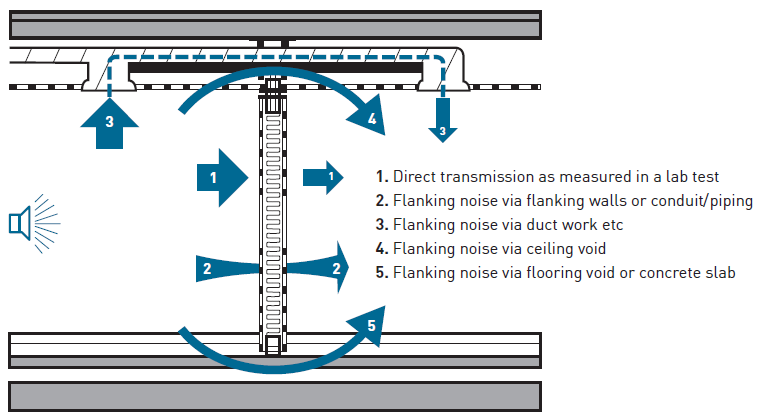
So it’s important to remember that results achieved in a laboratory, in perfect conditions, will not be replicated on site.
Summary
Once you understand the fundamentals of partition acoustics, and how they are tested and reported, you will be able to accurately compare products from different manufacturers. You will also understand how many factors within an office environment will have an impact on the noise levels, and what can be done to reduce this impact. If you’d like to learn more about our range of acoustic office partitions, get in touch with our team.